
Ilium Software eWallet 3.1
During the recent InfoSecurity Europe Conference held in London, security company Pointsec Mobile Technologies commissioned a PDA Usage Survey 2003. The results showed that 57% of the IT staffers who filled the survey, don’t encrypt the corporate data held on their Handheld device. A couple of days ago, someone bought a BlackBerry device over eBay and was stunned when he saw that the device contains a myriad of personal information about a well known financial services firm. These are just some of the latest headlines showing that there is a need for software tools, securing this kind of information.
 For the first PocketPC software review on Help Net Security, I look at eWallet, a product by Ilium Software. eWallet is a tool that can contain all your private data in a compact and secure manner. The review is based on eWallet 3.1.OT running on a Microsoft Windows Mobile 2003 powered HP IPAQ 5550.
Configuration
Installation of the program went on smoothly. After downloading the 1.3 MB installation file, ActiveSync does its job and within a couple of seconds, this copy of eWallet gets its new home. From the configuration perspective, we can configure two things: the actual software functions and our depository of private information. The basic tool configuration offers the possibility of changing the default password and provides couple of “locking” rules. These rules include a possibility of the software locking itself after a desired period of inactivity or locking for a desired time frame, after a number of incorrect password attempts.
Usage
When eWallet is started for the first time, the user needs to create its cards or categories. Cards are information sets, which can be added into topical categories. Some of the default categories eWallet contains include: accounts, credit cards, financial, government, health, passwords and Internet. Categories are quite useful, as the user can easily find the needed information, located in one of the categories. Card creation is a simple process, as the user is presented with a graphical menu guiding the user through this input phase.
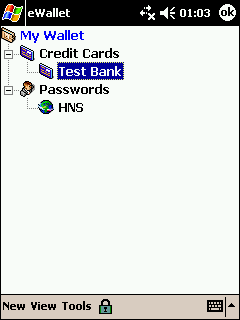
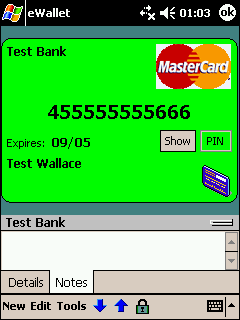
To make things look more personal to the users, eWallet offers some extra functions that can be used while creating cards. For instance, when inserting the credit card information, the software offers you to choose images, colors, icons and even sounds that will be associated to this data card. To visualize the cards, check the screenshots located below the review.
After adding all your data cards, it is time to close the software and see what it offers. By opening eWallet, we are greeted with the added categories and clicking one of them, opens a graphical password prompt. When the successful password authentication is accomplished, the data cards stored in the database are open for browsing and modifying. Software even contains search capabilities, which will be a great addition to those with tens or hundreds of information packed data cards.
Final comments
eWallet is a handy software tool that should be of a great use to a number of Handheld users needing to secure their private information. It is really easy to work with, looks great and offers all the functionality this kind of product should offer. eWallet uses industry standard 128-bit key RC4 encryption, which provides a satisfying level of security.
eWallet is available for Pocket PC, Palm-Powered Handhelds and desktop Windows. If you need handheld and desktop PC synchronization, there is a Professional Edition of eWallet that offers these capabilities.
Screenshots
Click to see a larger version.
 |
 |
eWallet icon in the Programs folder | eWallet’s password prompt |
 |
 |
New categories menu | Browsing created data cards |
 |
 |
Web site password card | MasterCard data card |