Latest news

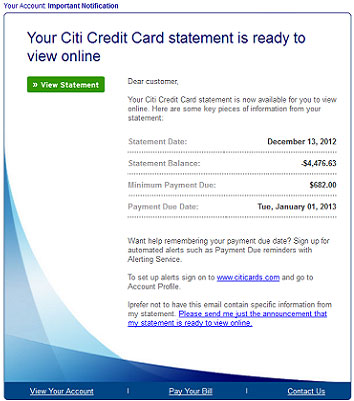
The emails contain “Your Citi Credit Card statement is ready to view online” in the subject line, and the attackers count on the large fake negative balance to make users follow the offered link, which will take them to a website hosting the Blackhole exploit kit.
"If the site is opened with Chrome, victims are presented with a page that urges them to download and install a malicious Chrome update. On the other hand, if the site is opened with other browsers, the user is almost immediately served a piece of malware via unpatched security holes in commonly utilized applications such as Java or Flash," shared Eduard Kovacs, and pointed out that this "quirk" is probably due to the fact that the aforementioned exploit kit has a hard time of infecting Chrome users.
As other researchers have noted, Blackhole takes advantage of Java, Adobe Reader and browser vulnerabilities, but Chrome does not use Adobe Reader to open PDF files and asks users permission to run a Java applet before doing so, essentially limiting Blackhole's effectiveness.


Spotlight

IT security jobs: What's in demand and how to meet it
Posted on 15 May 2013. | Let's say you want a career in information security, where do you start? What credentials do you need? What are employers looking for? Read on to find some answers.

Is Microsoft is reading your Skype communications?
Posted on 15 May 2013. | The question of whether Skype allows U.S. intelligence and law enforcement agencies to access the communications exchanged by its users has still not been adequately answered by Microsoft.

Internet Explorer best at blocking malware
Posted on 14 May 2013. | While Chrome’s malware download protection improved significantly, Internet Explorer 10 continues to outperform the other browsers with a block rate of 99.96%.

Researcher refuses to help Saudi telco to spy on people
Posted on 14 May 2013. | You would think that a Saudi Arabian telecom firm interested in monitoring its users' mobile communications would not be asking a well-known pro-privacy researcher for help, but you would be wrong.

Malicious browser extensions are hijacking Facebook accounts
Posted on 13 May 2013. | Facebook users - especially those in Brazil - are being targeted with malicious browser extensions trying to hijack Facebook profiles, warns Microsoft.
By subscribing to our early morning news update, you will receive a daily digest of the latest security news published on Help Net Security.
With over 500 issues so far, reading our newsletter every Monday morning will keep you up-to-date with security risks out there.